Find your Calm: 5 Simple Mindfulness Practices for a More Peaceful Headspace
Jeremie Miller, May 27, 2026
I remember reading that there is a large part of the population that walks around every day living in the present moment. They aren’t mentally busy running multiple future scenarios through their minds, questioning decisions they’ve made, or panicking about whether they are a good person.
I am not one of these people.
I spend most of my day working for RAFT, and most of my downtime, thinking. Did I answer that person’s questions the best way? Am I saving enough for the future? Is RAFT using the best strategy in this situation? Should I be doing more to be a good person? Am I a good person?
At times, these negative thoughts end up controlling me and putting me in a bad headspace. They can impact my relationships with colleagues, friends, my family, and myself. At their worst these thoughts can trigger my depression.
If you are doing purpose-driven work that you care about, these thoughts can be amplified. If you are a leader of people doing purpose-driven work then, if you are like me, these thoughts can be overwhelming.
If you are nodding your head and all of this makes sense, this post is for you.
In this post, I am going to share five of the mindfulness practices I have been using to interrupt or prevent negative thoughts, reduce anxiety about the past and the future, and live life more in the present moment. Hopefully, you will find at least one - if not more - of these practices helpful.
#1 Dealing with the negative thoughts in your head
Years ago, the book “Shambala: The Sacred Path of the Warrior” suggested that, when I am having intrusive thoughts, or the doubt voices are taking control, to think, “Oh look, there is a thought. Thank you, thought.” then dismiss the thought and move on.
This has never worked for me.
What does work is a very similar technique from the YouTube channel Calm Sparrow. When you are having an intrusive thought that is taking control of your mind, follow these three steps:
- Think: “I can hear this thought, so it isn’t my voice speaking.”
- Think: “If it isn’t my voice, I am going to stop listening.
- Stop listening to the voice and focus on your breathing.
Not so different from the “oh look, there is a thought. Thank you, thought,” method - but for me, identifying that the thoughts I am having are coming from a separate voice, allows me to successfully stop listening, silence the voice, and be present in the moment.
(For a more in-depth explanation of this technique, watch Calm Sparrow’s video here: When You Finally Stop Living in Your Head, Life Becomes Peaceful Again https://youtu.be/OLMAg2lnoyY?si=Ma7mgn1IjQmteiRR)
#2 Three steps to Focus on your breath
Simply focusing on my breath is also something I have struggled with throughout my mindfulness journey. When I am in a place where the negative thoughts and voices are quiet and I just need to ground myself, I use box breathing.
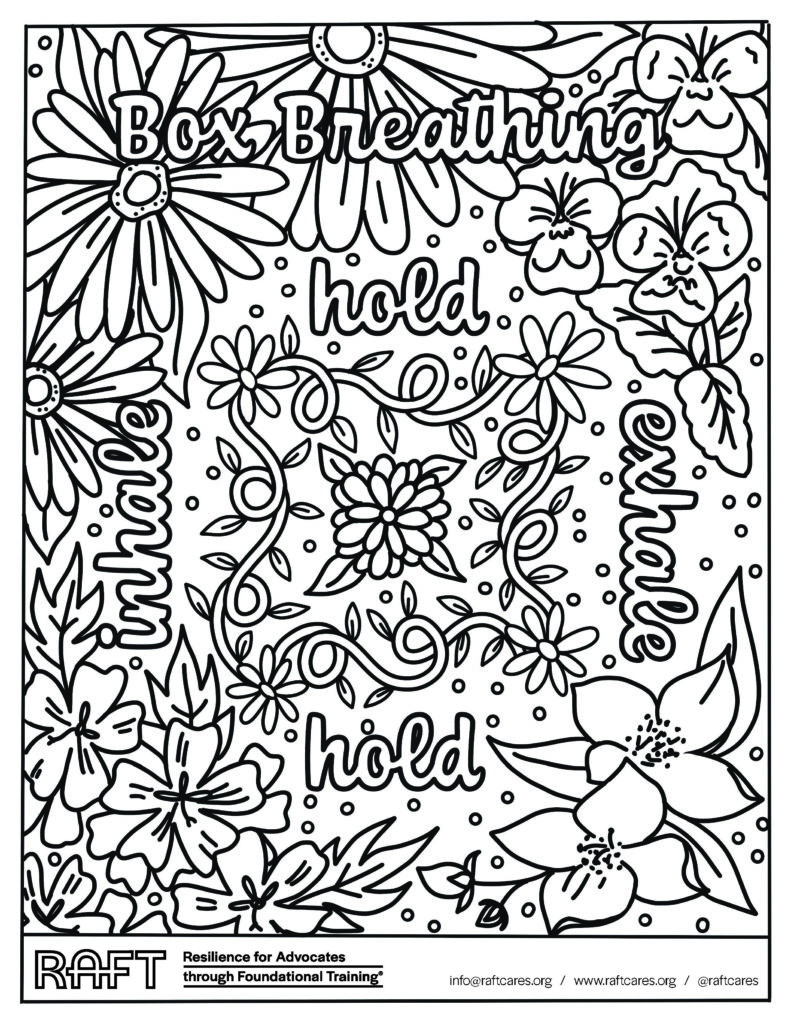
RAFT uses box breathing in all of our workshops and you can download a coloring page with the instructions here.
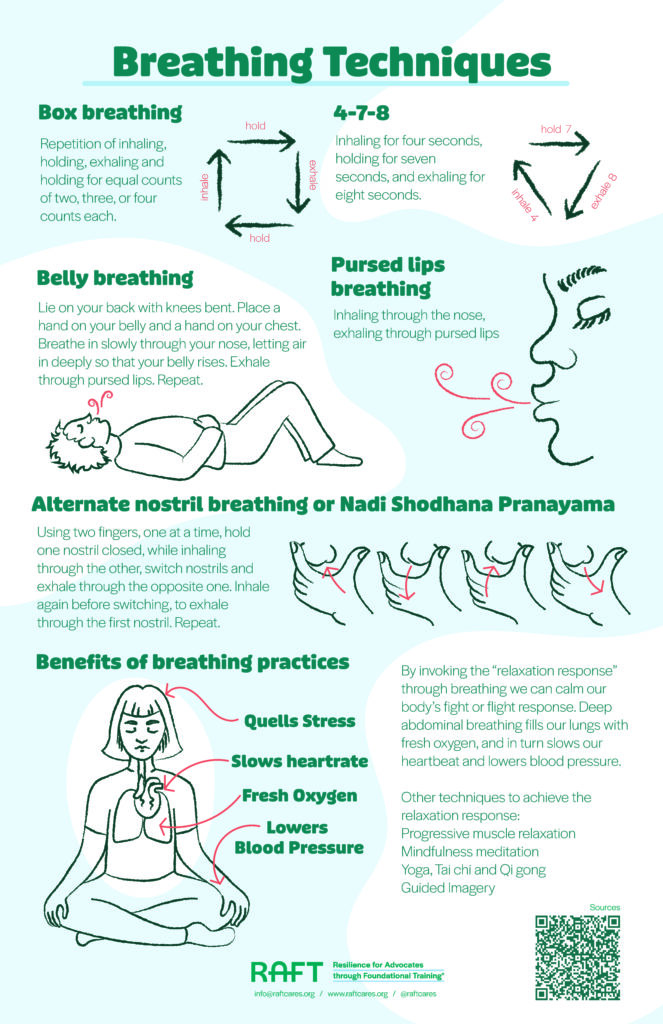
If you are interested in different breathing techniques, you can download a poster on breathing techniques here.
However, when I am pestered by negative thoughts in my head, box breathing doesn’t cut it. I recently found a breathing technique has made a huge difference in my ability to quiet negative thoughts, be more present, and reduce anxiety.
When the thoughts and voices are winning and taking control, I do three things:
- Feel something physical in my space: my body in the chair, the keys under my fingers, the wind on my face, etc.
- Hear a noise around me: the sound of the furnace, the music I’m listening to, a dog barking, etc.
- With each long inhale, I think “I am breathing in.” With each long exhale, I think “I am breathing out.”
I continue repeating these steps until the negative thoughts are gone and I am focused on my breath and the present moment.
These three steps -especially number three-, have a high success for clearing my head of negative thoughts and helping me be more present.
#3 Wait, there’s more than one type of worrying?!?
When I am struggling with my thoughts there is another technique from Calm Sparrow that I find useful. To start this practice, I ask myself: What type of worry is this?
Calm Sparrow identifies three types of worry:
- Practical worry – you are worried about something you need to do AND can act on.
- Rehearsal worry – replaying the same anxious scenario in your head, even though you cannot act on it because it has already happened or it hasn’t happened yet.
- Identity worry: confirming a belief you hold about yourself or how life works.
Like the “this isn’t my voice, so I don’t have to listen to it” technique, identifying the type of worry helps disrupt negative thoughts:
- If you have a practical worry figure out the next action you need to take and either take it or write it down to act on later.
- If you have a rehearsal worry or an identity worry refer back to practice #1 and use the three steps to stop listening to the voice.
Calm Sparrow explains the three types of worry and what to do with them with more detail in this video.
#4 Guided Meditations
Practices 1-3 are all dependent on me being able to use the technique and follow through on my own. This doesn’t always work. Sometimes I need support interrupting the negative thoughts.
I have found guided meditations to be very helpful in getting the support I need to be present and put myself in a better place.
Specifically, I use three types of guided meditation:
- I listen to a 10-minute guided meditation every morning before I start my work for RAFT. This is a form of prevention. If I listen to the 10-minute guided meditation, then I find my mind is more resilient and the negative thoughts don’t even start.
- If negative thoughts do start to push their way into my mind during the day, then I use a shorter guided meditation, usually 1 minute or 5 minutes, to support me in interrupting the thoughts in my head and return to the present moment.
- If neither of those is working, I need to add movement into my mindfulness practice. To do this I will get out of my desk and go for a walk while listening to a walking meditation. Getting my body and mind working together (especially outdoors) is a powerful method for me to regain control of my thoughts and be present.
You can do a search on YouTube and find lists of all these different guided meditations. Find the ones that work best for you and listen to them as needed.

#5 Meditation Music Playlists
To be honest, none of the practices work 100% of the time. The negative thoughts in my head have had years of practice and can continue to overwhelm all these tools. If I find myself struggling, and I can’t quiet my thoughts, it is time to turn on the music.
I will use YouTube, or Apple Music and search for “meditation playlists” then pick one of the many results and hit play. I will listen to the playlist while working, walking the dog, or when sitting in silence isn’t working. The music calms me and fills my mind with a sound that isn’t the negative thoughts in my head. It doesn’t work immediately, but after a few songs the thoughts are pushed out, my brain is filled with music, and I can return to focusing on the present.
(A shout out to Stranger Things and the character Max constantly listening to Kate Bush to protect herself from Vecna, which inspired me to try this)
Which of the five practices will you start with?
With this “quiver” of mindfulness practices ready to use I have had a much healthier state of mind with the start of the new year. By having more than one mindfulness practice to use I can almost always interrupt the unwanted thoughts and return my mind to the present moment. I will admit that not having the negative thoughts in my head all the time feels strange, like losing a part of me. However, the more I find my mind at peace, and the more I can be present with my work, family, and friends, the more I am happy to say goodbye to that part of me.
I didn’t start using all five of these practices at once. I gathered them over the final quarter of 2025 and the start of 2026. If this post resonates with you, pick one of the five that feels like the best fit for you and give it a try. If it works keep using it, if it doesn’t, try something new. Silencing the negative thoughts in your head is a journey, and it will take time, but I think it is time well spent and can support you in being a healthier and better advocate in the gender-based violence ecosystem.