Progress Over Perfection
Sophie Strachan, May 13, 2026
Do you find yourself stuck in Perfection Paralysis? That anxious feeling that if you don’t do all the research, or execute a task perfectly, then you have failed? As a supervisor, do you expect your staff to complete tasks perfectly every time? Or do you give them the space to Fail, Learn, and Grow?
Living with a perfectionist mindset leads to anxiety and a fear of making mistakes; it leads to shame, and low self-image. For staff, it can manifest as a fear of asking for help, procrastinating to complete tasks, and burning out when they push past their capacity.
For staff, this might show up as:
- Hesitating to ask for help
- Putting things off because it doesn’t feel “ready”
- Pushing past capacity just to meet an impossible standard
For supervisors, it can look like:
- Rigid expectations around policies and processes
- Holding staff to unrealistic or unclear standards
- Expecting people to operate at 100% all the time
Realistically, we’re human, we’re fallible, we’re not perfect, and we won’t operate at 100% every day. We can't expect that of ourselves, or our coworkers. When perfection becomes the standard, failure becomes inevitable.
And over time, that doesn’t build stronger teams... it builds burnout.
So, what standards can we strive for instead? Progress!
Consistency
Consistency is more than simply completing a habit every day. It can also mean accomplishing that habit a few times oneweek, one time the next week, and every day the following week! Consistency doesn’t need to be perfect to create a habit and, in turn, make progress.
Have you ever set a New Years resolution to cut down on your screen time? Or go for a walk every day? You start off strong and motivated but after a week or two, your new habits start happening less. Until you’ve completely abandoned them. We call this phenomenon habit burnout.
“Habit burnout happens when the systems designed to improve your life become sources of stress. It's the exhaustion that comes from maintaining too many habits, setting unrealistic standards, or losing sight of why you started in the first place.”
So how do we build consistency in a way that actually lasts?
We start by doing less and doing it more intentionally.
- Start small. Introduce one new habit or process at a time... maybe once a week, or even once a month.
- Build gradually. Let yourself increase the frequency over time instead of expecting an instant routine.
- Give yourself checkpoints. If you’re learning something new at work, revisit the process or instructions to stay grounded and supported.
Over time, what once felt effortful starts to feel natural.
When you keep your eye on the bigger picture, rather than conforming to rigid standards of success and you’ll find that consistency comes easy. Because when we let go of perfection, we create space for something much more powerful: sustainable growth.

Proactivity
Make it happen, and you can perfect it later. Procrastination is one of the biggest barriers to progress. And while it can show up in different ways, at its core, it’s often rooted in fear -- fear of failing, fear of being judged, or fear of not doing something “well enough.”
How do we get past the mental block of procrastination? It’s easier said than done. You must push through the perfection paralysis and just start. Start with step one, lower the stakes, and practice! When a painter is creating a new work of art, they don’t always start on the canvas. They sketch in their sketchbook multiple times, they test color palettes, and once they are painting, they might still adjust the composition before the painting is complete. Your work can follow that same rhythm. It doesn’t have to be perfect to begin, it just has to begin.
At RAFT, one of our values is “Fail, Learn, Grow.” It’s more than a phrase... It’s a process. And more importantly, it creates a culture where trying something new feels safe. When there isn’t fear of punishment or criticism, there’s more room for creativity, learning, and growth.
You can bring this into your own work and team spaces, too:
- Try something new
- Reflect on what worked and what didn’t
- Name what you learned
- Use that insight to move forward with intention
If you’re looking for a place to start, we’ve created a Fail, Learn, Grow debrief template you can use for projects, staff check-ins, or new initiatives.
It’s a simple way to turn action into learning and learning into growth.
Skill Acquisition
Progress means learning... and learning means growth. We’ve all heard the phrase “Practice makes Perfect.” But what if we reframed it to something a little more realistic (and a lot more compassionate):
Practice makes progress. Because it’s true. Maybe not as quickly as we’d like, but every time we try, every time we follow something through, we’re building skill.
Look back on your life 1 year ago, 5 years ago, 10, 15 years ago. Can you see how much you’ve learned? How far have youcome from where you started? Growth doesn’t always feel obvious in the moment but over time, it adds up in powerful ways. And here’s the part we don’t always say out loud: It can take a lifetime to truly master a skill. So if you don’t immediately excel at something new that’s not failure. That’s the process.
Think back to when you first learned how to ride a bike. Or even something like writing in cursive. At first, it felt awkward. Unsteady. Maybe even frustrating. But with repetition, something shifted. You found your balance. Your rhythm. Your flow.
Skill-building works the same way. It’s a repetitive process and whether it feels fun or challenging in the moment, it’s still progress. And one day, you’ll look back and realize... you’re already doing the thing that once felt impossible.

Output
So, how do you actually measure progress?
A helpful place to start is shifting your focus. Instead of centering on what didn’t happen, look at what did: What moved forward? What was completed? What improved, even a little? Progress isn’t linear, just like life and emotions; it ebbs and flows. Somedays it will be more apparent than others.
At RAFT, we build this mindset into how we work. When we test new systems or processes, we do it in quarterly cycles. That gives our team time (about three months) to practice, experiment, and reflect.
Then, during our team meetings, we come together to ask:
- What’s going well?
- What’s not working?
- What can we adjust moving forward?
There’s no shame in something that is not working. It’s simply information and an opportunity to grow.
If you’re trying something new, it can help to define what “progress” looks like for you. These don’t have to be rigid or perfectbut they should give you something to reflect on.
You might measure progress through:
- Numbers (e.g., practicing twice a week, completing 10 rounds)
- Feelings (e.g., more confidence, less stress, increased clarity)
- Completion (e.g., a checklist of tasks or milestones)
And when it’s time to evaluate, try approaching it with curiosity instead of judgment. Instead of asking, “What did I do wrong?”
Try asking:
- What went well?
- What could have gone better?
- What did I learn?
- What can I try differently next time?
- What ideas (big or small) came from this process?
Because when we remove blame, shame, and judgment, we create space for something much more useful: honest reflection, meaningful learning, and continued growth.
Progress Over Perfection
Humanity is an imperfect species, so why hold yourself or your staff to impossible standards? Instead let’s measure our successes, in life and at work, through:
- Consistency – Showing up over time. Think once a week for a year, rather than every day for a month.
- Proactivity – Just start, and perfect it later!
- Skill Acquisition – Focus on learning, and improving, rather than doing everything “right.”
- Output – Measure your progress. Progress grows slowly and tracking it will make it more apparent.
Progress doesn’t always feel big in the moment but over time, it builds into something meaningful.
And sometimes, we just need a little reminder along the way.
✨ Need one? Download our coloring page here:
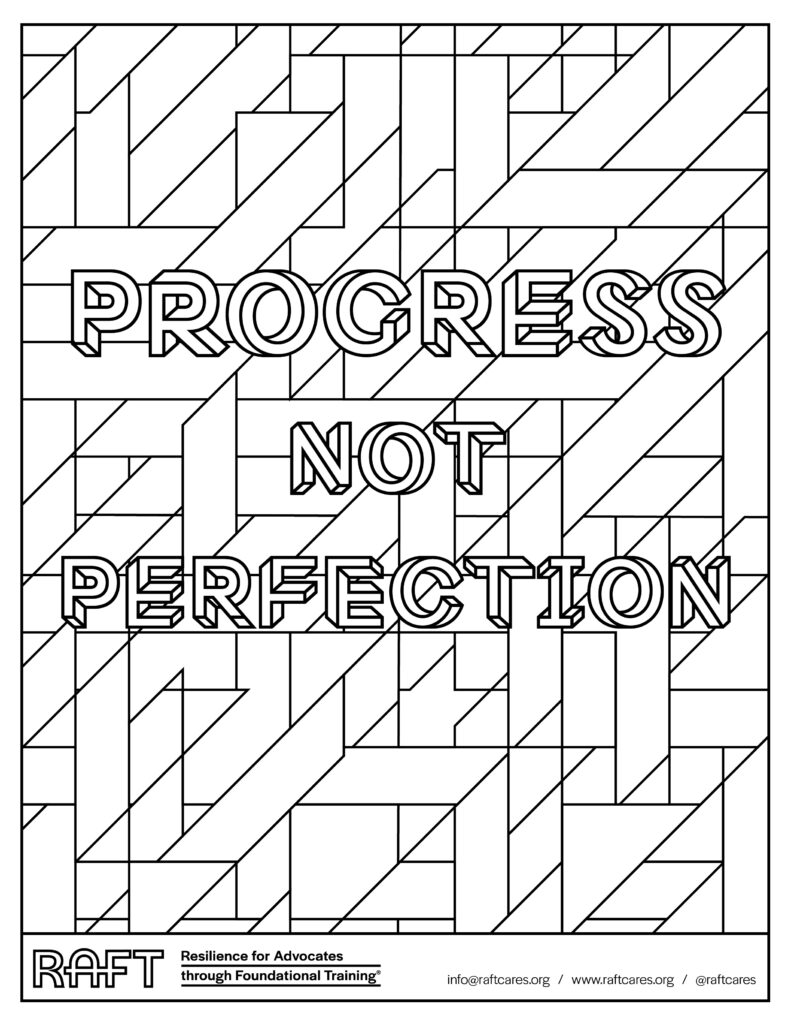
✨ Small, imperfect steps - taken consistently - create lasting change. You don’t have to get it perfect... you just have to keep going! ✨